
The 8 Most Dangerous Myths about Learning
If you believe these myths, you’re only reaching 20% of your potential. If that.
Use this article to learn the truths, shed the old myths, and join today’s learning revolution.
4 minute read

 One of the world’s greatest learners — ever: Nobel Prize-winning physicist Richard Feynman. He said it best: “The first principle is don’t fool yourself — and you are the easiest person to fool.”
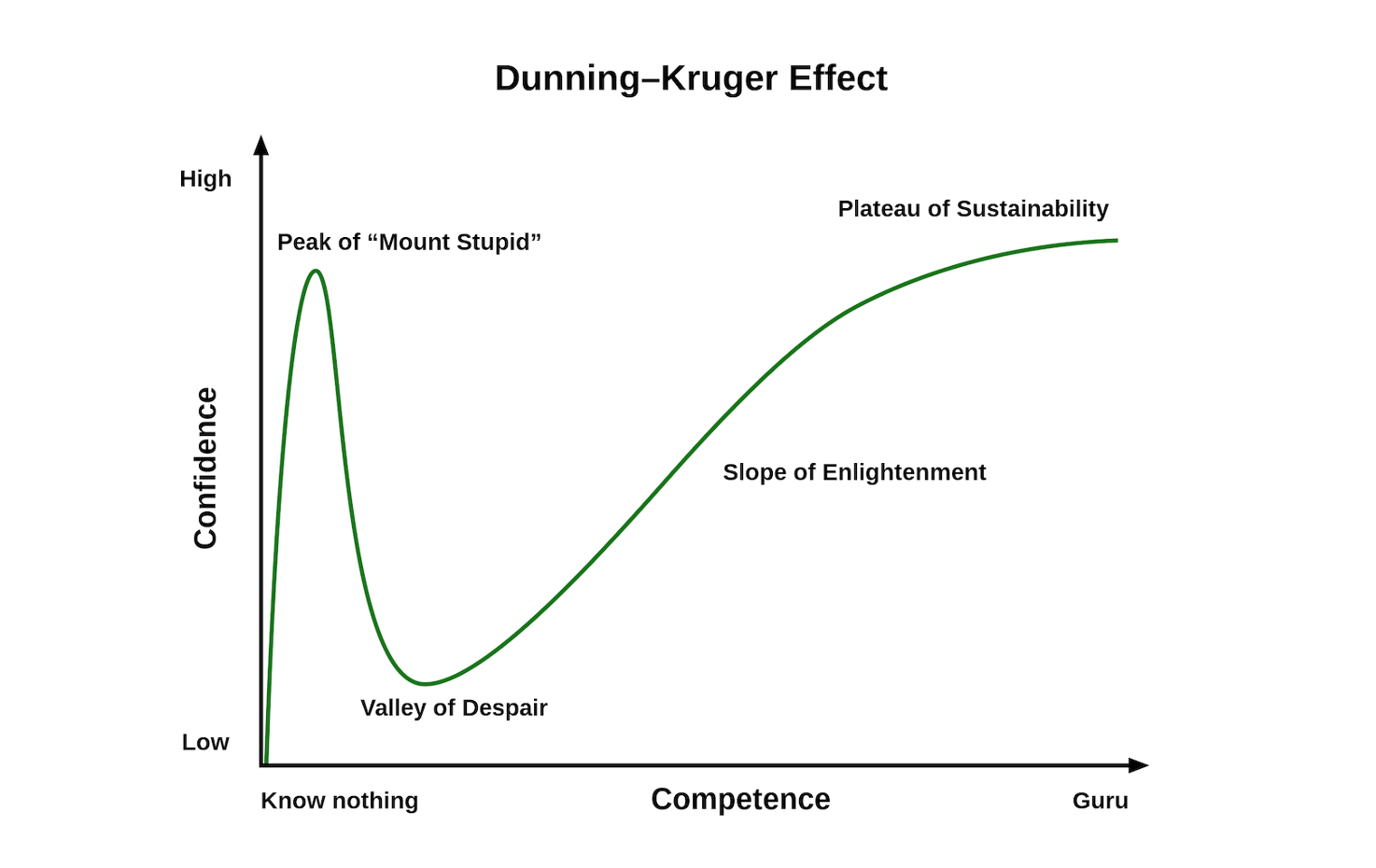
Most people let these 8 myths undermine their learning. Then, to try to fake it, the try to pump themselves up with confidence even where they don’t have competence. It’s called the Dunning-Kruger Effect.
Idea in Brief
[Oct. 12, 2025] Ok – D. You’ve now got the Articles Design Blueprint and the L2 Article Modus Op AND the SF Articles Page 3.0. You should be producing 1,000-word articles DIRECTLY on the SF Articles Page … in record time. Also, integrated into the Articles Design Blueprint the additional tools of: (1) PASS PITH as the additional guidelines for copy; (2) specific guidelines on writing the SHORT ‘Idea in Brief’ section asap.
[Previous text in the SFAP][June 5, 2024]: I’m now adding further text to this initial Text Module 1, as I did in the Testing Version of this SFAP. The aim is to see how it looks to have a relatively full Idea in Brief section that’s about the same height as the Related Articles box on the right. [June 4, 2024]: This is a new Text Module 1 in this Column…
In Practice [Text Module 2]
[June 3, 2024]: Based on what I’ve done so far, it looks like the bouncing occurs or can occur when there’s TOO MUCH text in a single Text Module that then needs to get formatted into two columns according to the CSS code. …
Action Steps [Text Module 3]
[June 4, 2024]. This is new text. The idea is to have a concise summ of the key action step a reader should start taking.
Related Topics or Articles
Introduction
D … in short articles of 1,000 words, you might not even need a heading called ‘Introduction.’ You certainly don’t want any Subheadings here. That’s way too cluttered. If you DO have an Introduction, it should simply be the introduction of the Pain Point. Then, Section 1 (Story / Pain points) is the Amplification of the pain. (PA in PASS PITH).
These 8 Myths Will Block 80% of Your Potential
This is a separate Text Module for Body Section 1. It necessarily must remain in the same ROW for the full Article Body.1THIS is where you can now start to get into more serious setting out of cites and references.
Subheading 1 [H3]: The question though is what does this look like as a longer subheading?
This now tests a Subheading sub-section where the Subheading title is a short sentence or perhaps a question. The H3 line height should be set throughout at 1.1em. The default setting of 1em makes these lines a bit too close.
Subheading 2 [H3]
This would be text under the second Subheading the in Intro. Note that I generally think the first Footnote/Sidenote in the Intro/Body should come (at the earliest) at the end of the Intro. Generally, you want to keep the Introduction extremely simple and fast-paced pcmf/story.
 This is Option 1 for including an Image and Text within the Body of the Article: Text Module … with the Sizing adjusted in Design to make the image smaller (e.g., 3/4 size) (Settings: Margins on L and R to 100px, Font Size: 12px). Text Module allows you to have text below the image … in the SAME Text Module.
Body, Section 2 Title [H2, black.]
This is the OPENING SENTENCE for Body Section 2. Set out in the Single Guide how even an Opening Sentence of a section must still be a great opener … intriguing … creating an info gap or other element that triggers curiosity.2THIS is where you can now start to get into more serious setting out of cites and references.
Subheading 1: What If … ____?
This now tests a Subheading sub-section where the Subheading title is a short sentence or perhaps a question. The H3 line height should be set throughout at 1.1em. The default setting of 1em makes these lines a bit too close.
Subheading 2
This would be text under the second Subheading the in Intro. Note that I generally think the first Footnote/Sidenote in the Intro/Body should come (at the earliest) at the end of the Intro. Generally, you want to keep the Introduction extremely simple and fast-paced pcmf/story.
Body, Section 3 Title [H2, black.]
This is a separate Text Module for Body Section 1. It necessarily must remain in the same ROW for the full Article Body.3THIS is where you can now start to get into more serious setting out of cites and references.
Subheading 1 [H3]
This now tests a Subheading sub-section where the Subheading title is a short sentence or perhaps a question. The H3 line height should be set throughout at 1.1em. The default setting of 1em makes these lines a bit too close.
Subheading 2 [H3]
This would be text under the second Subheading the in Intro. Note that I generally think the first Footnote/Sidenote in the Intro/Body should come (at the earliest) at the end of the Intro. Generally, you want to keep the Introduction extremely simple and fast-paced pcmf/story.
Key Takeaways | Take Action [H2, black.]
This is a separate Text Module for Body Section 1. It necessarily must remain in the same ROW for the full Article Body.4THIS is where you can now start to get into more serious setting out of cites and references.
Key Takeaway(s) [H3]
This now tests a Subheading sub-section where the Subheading title is a short sentence or perhaps a question. The H3 line height should be set throughout at 1.1em. The default setting of 1em makes these lines a bit too close.
Take Action [H3]
This would be text under the second Subheading the in Intro. Note that I generally think the first Footnote/Sidenote in the Intro/Body should come (at the earliest) at the end of the Intro. Generally, you want to keep the Introduction extremely simple and fast-paced pcmf/story.
References & Further Reading
- 1THIS is where you can now start to get into more serious setting out of cites and references.
- 2THIS is where you can now start to get into more serious setting out of cites and references.
- 3THIS is where you can now start to get into more serious setting out of cites and references.
- 4THIS is where you can now start to get into more serious setting out of cites and references.