
Start Here: Top Insights from 200+ Cases of Successful Change … and 50+ Failure Stories
The people who have shaped history, above all else, mastered the skill of cutting to the root cause of a problem and solving that problem. The effect is exponential.
My aim is to show you what they did, and help you do the same.
“Your time is limited. So don’t waste it living someone else’s life.”
— Steve Jobs, co-founder and CEO of Apple from 1977-1985 and 1997-2010
5 minute read
 “The first principle is don’t fool yourself — and you are the easiest person to fool.” Nobel Prize-winning physicist Richard Feynman
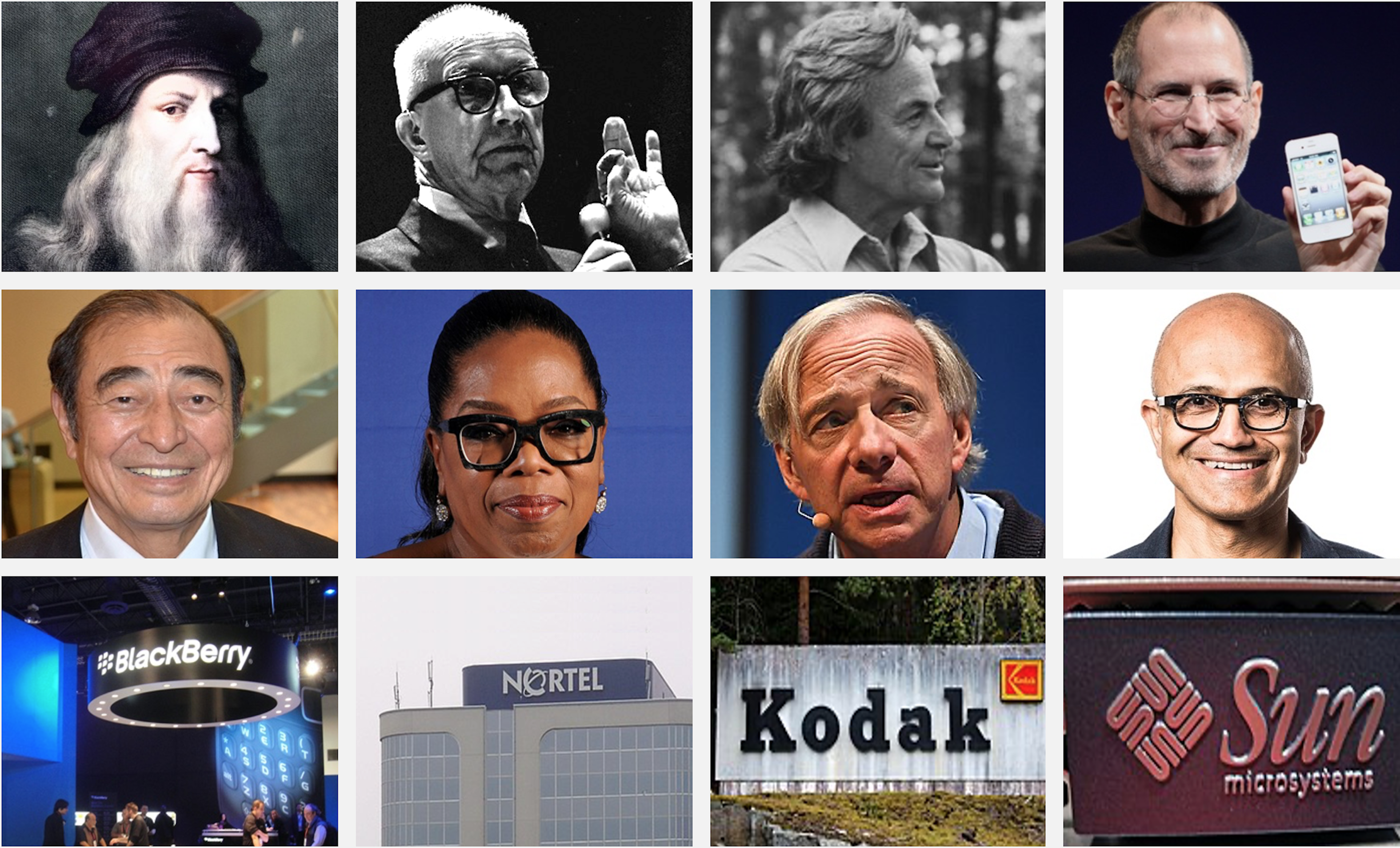
Top Examples: Eight compelling success stories, and four of the failure stories (Credit: Wikimedia)

“The first principle is don’t fool yourself — and you are the easiest person to fool.” Nobel Prize-winning physicist Richard Feynman
Idea in Brief
[…] …[Mar. 8, 2025]: Basic idea: the Start Here page should make lots of references to your unique differentiator that you’re ‘the guy’ who studied and shares actionable insights from 200+ cases of successful change and 50+ failure stories. To make that a regulat thing people focus on, you should embed a hyperlink (as appropriate) IN that text … namely 200+ cases of successful change and 50+ failure stories. <– So … check how that works. That’s an initial example of the kind of hyperlink a reader should be able to readily click on here.
[ ]
In Practice
[… ] …
[…]
Action Steps
[…] …
[ … ]…
Related Topics or Articles
For an introduction to the top examples and key lessons from the 200+ cases of successful change and 50+ failure stories, check out:
Introduction
[ … ]
The New ‘AI’: Actionable Insights
[ … ]
…
The Even Better ‘AI’: Accelerated Implementation
[Feb. 19, 2025: D – previously I had a subtitle mentioning ‘Use the FAQs’ … it’s not necessary as a subtitle. Put the Heading ‘FAQ’s (Frequently Asked Questions) in the Resources section of the Footer..[…].1As a general rule, I think you want to develop a kind of standard practice for the first Footnote/Sidenote: for example, it should get straight to a kind of personal recommendation from me. That would nicely set the tone that these are NOT classic ‘references’ just there as citations. These are intended to provide a lot of further VALUE and UX.
200+ Cases of Successful Change: One Message
[ … ]… .2THIS is where you can now start to get into more serious setting out of cites and references.
The Old Way to be ‘Smart.’ It’s Today’s Path to Failure
[ …]
The New Way to be Smart
[ …]
The Power of a Simplified Starting-Point Framework
[ …]
[ … ] …
This is Option 1 for including an Image and Text within the Body of the Article: Text Module … with the Sizing adjusted in Design to make the image smaller (e.g., 3/4 size) (Settings: Margins on L and R to 100px, Font Size: 12px). Text Module allows you to have text below the image … in the SAME Text Module.
Start Here: The 8-Part Framework
This is the OPENING SENTENCE. Make it great.
This is the segue to the first area in the SP Framework. 3THIS is where you can now start to get into more serious setting out of cites and references.
1. Personal Mastery | How to Think
In the success stories, you’ll find a phenomenal role played by high self-mastery and personal growth.
In the failure stories, not so much. Often, errors here are the very cause of a collapse or downfall.
I therefore put this crucial area at the top of the list. It”s the very foundation of Meta-Intelligence, and of success in everything else.
Let’s look at a few examples.
Personal Mastery FAQs
[now marshal about 3 one-sentence examples … namely: Shigetaka Komori at Fujitsu … Satya Nadella at Microsoft … Steve Jobs in the 2000’s at Apple …
The task also now is to fully develop the whole ’48 & 33 Applied’ particularly with regard to ‘People only know you from what they SEE’ and ‘Make your accomplishments look effortless.’
What often looks like great leadership on the outside is actually the result of a leader’s longstanding commitment to Self-Growth on the inside. Steve Jobs may be the world’s leading example. As business professor Jim Collins writes, the remarkable accomplishments of Steve Jobs through the 2000’s were not carried out by the same Steve Jobs we saw in Apple’s early days. He had grown in several crucial ways compared to the leader he was in the 1980s.4Steve Jobs: As business author Jim Collins writes in his book Entrepreneurship 2.0: “It would be a mistake to assume that ‘Jobs 2.0’ [the more seasoned Steve Jobs who returned to Apple in 1997] was the same leader he was in the 1980’s.” He was not. He had transformed himself through the 1980s and 1990s through a series of enormous challenges and sometimes bitter experiences. … D – now provide a proper MLA cite to the book … and systemize this so you MYALE. Here is the MLA citation copied from the ‘Bibliography’ setting in Zotero: Collins, James C., and William C. Lazier. Beyond Entrepreneurship 2.0: Turning Your Business into an Enduring Great Company. London: Random House Business, 2022. (I then added the embedded link to the amazon.com page … since people SHOULD buy these top books. Next Action: Systemize this in the SFAP … and optimize this use of automation tools and apply MYALE … and also add your PERSONAL TOUCH (UX) own suggestion as to what parts of it should be read.
[This would be the final closing line of this subsection.]5D – Make the final FN in this MI 1 sub-section … a great set of UX links to key examples, authorities, proof.
2. Relationships | How to Communicate
[ …]
….
3. Mastery | How to Learn
[ …]
….
4. Purpose | How to Focus
[ …]
….
5. Creativity | How to Deliver Value
[ …]
….
6. Habits | How to Systemize
Th
[ …]
….
7. Money | How to Appreciate & Build Genuine Value
[ …]
….
8. Tech | How to Make Tech Serve Humanity (and not the other way around)
[ …]
….
Harness the Insights | Customize Your Own Plan
[ …][Make the key point here … or repeat it … that the idea is to keep USING the same basic 8-Part Framework … especially so you integrate the essentials … while also building your own game plan by tailoring the set of insights to your own specific needs and aspirations.
…..6THIS is where you can now start to get into more serious setting out of cites and references.
Tailor the Insights to Your Own Needs
[ …]
….
Tap into the Unseen Magic of Your Own Mind
[ …]
….
Article Summary | Key Takeaways | Next Action Steps
[ …]
…..7THIS is where you can now start to get into more serious setting out of cites and references.
Article Summary
[ …]
Key Takeaway(s)
[ …]
….
Next Action Steps
[ …]
….
References & Further Reading
- 1As a general rule, I think you want to develop a kind of standard practice for the first Footnote/Sidenote: for example, it should get straight to a kind of personal recommendation from me. That would nicely set the tone that these are NOT classic ‘references’ just there as citations. These are intended to provide a lot of further VALUE and UX.
- 2THIS is where you can now start to get into more serious setting out of cites and references.
- 3THIS is where you can now start to get into more serious setting out of cites and references.
- 4Steve Jobs: As business author Jim Collins writes in his book Entrepreneurship 2.0: “It would be a mistake to assume that ‘Jobs 2.0’ [the more seasoned Steve Jobs who returned to Apple in 1997] was the same leader he was in the 1980’s.” He was not. He had transformed himself through the 1980s and 1990s through a series of enormous challenges and sometimes bitter experiences. … D – now provide a proper MLA cite to the book … and systemize this so you MYALE. Here is the MLA citation copied from the ‘Bibliography’ setting in Zotero: Collins, James C., and William C. Lazier. Beyond Entrepreneurship 2.0: Turning Your Business into an Enduring Great Company. London: Random House Business, 2022. (I then added the embedded link to the amazon.com page … since people SHOULD buy these top books. Next Action: Systemize this in the SFAP … and optimize this use of automation tools and apply MYALE … and also add your PERSONAL TOUCH (UX) own suggestion as to what parts of it should be read.
- 5D – Make the final FN in this MI 1 sub-section … a great set of UX links to key examples, authorities, proof.
- 6THIS is where you can now start to get into more serious setting out of cites and references.
- 7THIS is where you can now start to get into more serious setting out of cites and references.