
Primer 1 on the Science of Learning: The 4 Pillars of Learning
Most people are going about learning in the wrong ways.
They are still unaware that there’s a thing called the Science of Learning, that it has debunked dangerous old myths, and that we now have clear, superior, science-backed methods for genuine learning.
Ignore this science and these proven methods at your peril.
The best way to get started is to master the Four Pillars of Learning described below.
5 minute read
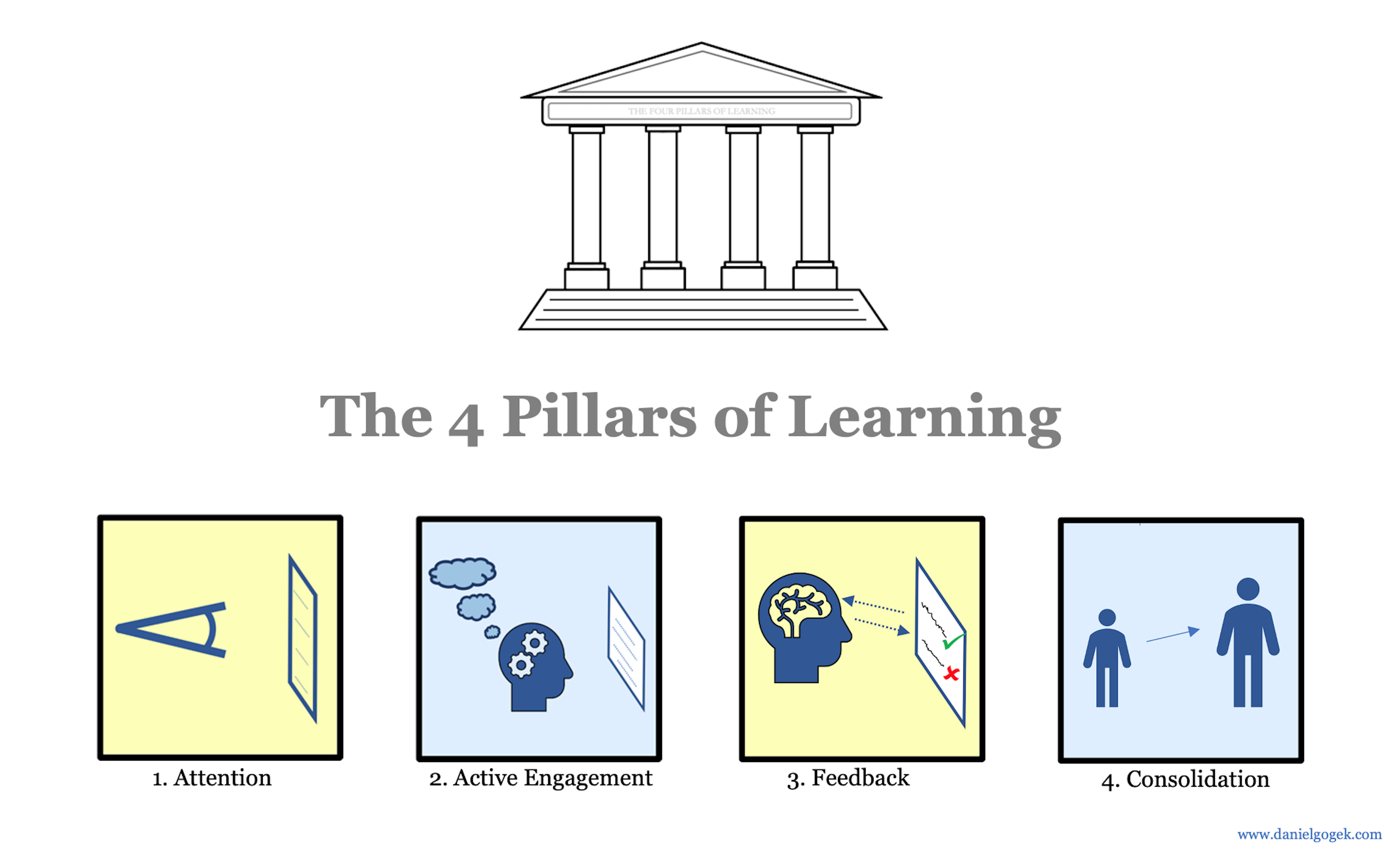
To accelerate your learning, master the 4 Pillars of Learning.
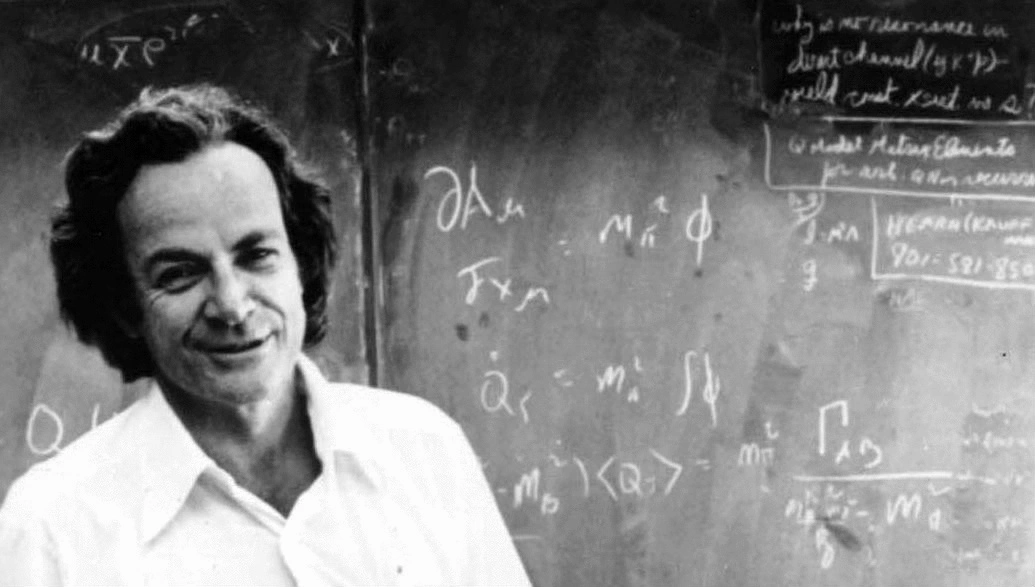 “The first principle is don’t fool yourself — and you are the easiest person to fool.” Nobel Prize-winning physicist Richard Feynman
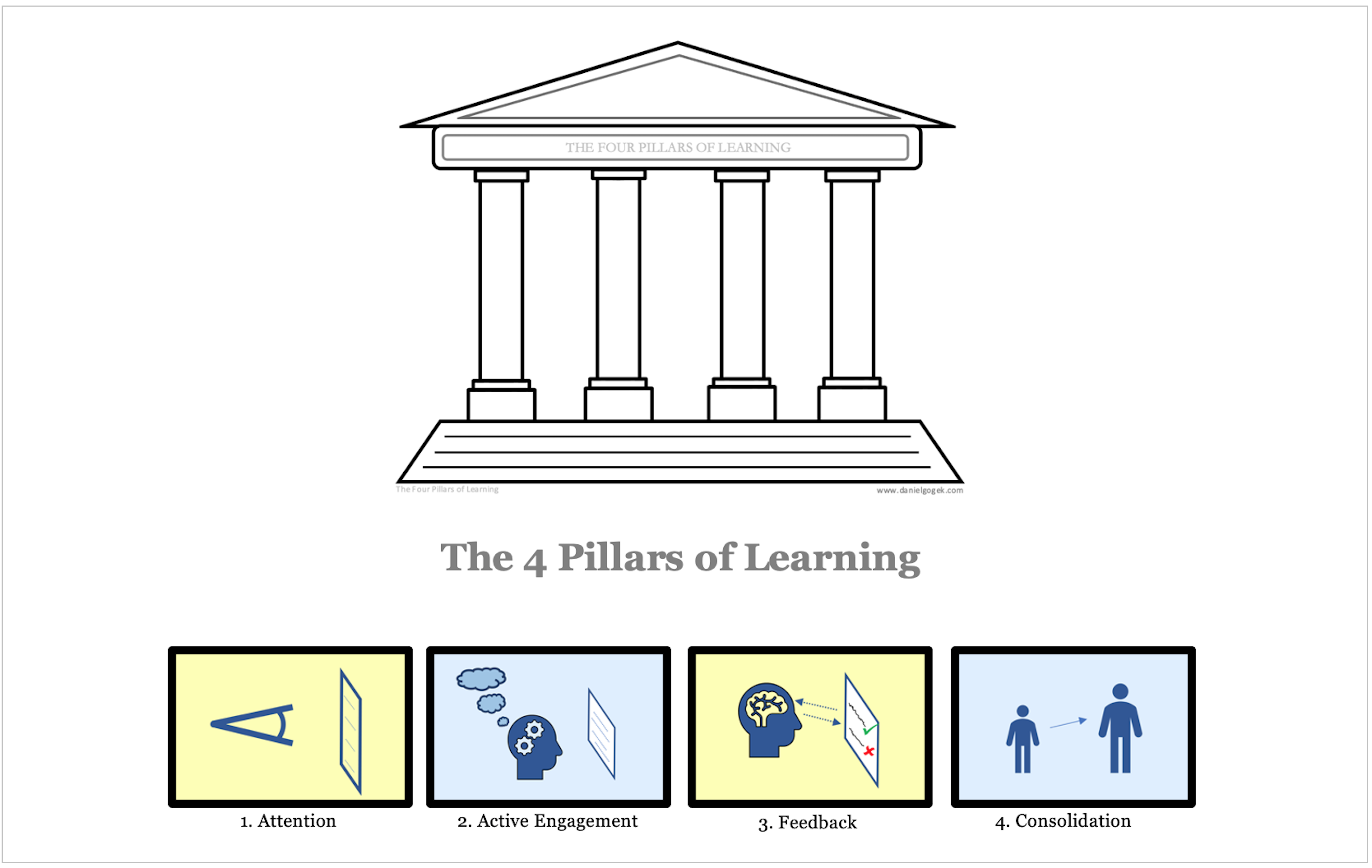
30+ years of research, one core finding: the ‘Universal Human Learning Algorithm’ called the 4 Pillars of Learning
Idea in Brief
[Nov. 30, 2024 ]: Okay … see now the previous ‘counterpart’ draft of this Page … that has saved all the previous notes … and will keep them there as a draft Page.
THIS now needs to become the published Page asap. It also needs to fully adopt the methodology developed after starting to do the SC iNotes Vids. In a nutshell, the clear NEED is for a Resource Page like this to be VERY limited in scope and length … and that means to serve as basically the INTRO to the topic/area … and a kind of Menu with LINKS to YOUR specific and SHORT articles on the very specific sub-topic … where that ‘next article’ provides a very focused MICRO LESSON … and preferably has a new TOOL or other hands-on exercise that they can start USING.
First Subheading: […] .
Learning Outcome: [ … ]
Growth Objective: [… ]
Related Topics or Articles
Introduction
[Opening Line … Lead … get to the positive outcome.
[ ..]
Most People are Going About Learning in the Wrong Ways
[ The A in PA ]
The price is very high today for those who fail to embrace these superior and proven methods of learning.
Part I. How Every Human Being Learns: The 4 Pillars of Learning
[D – given the relevant Huberman clips … I now do think that this intro of the basics should include links to these more active YouTube sources as well. That adds both cred and value.
1. Attention
This is a separate Text Module for Body Section 1.
[D – ie. … cite the essentials from Ch. 7 in Dehaene … and then cite the essential key quote from Huberman in the clip on the 2 stages … where he totally agrees that Attention/Focus is the starting point (or Pillar 1] [The key is to have A LOT OF SOURCES that cite Attention/Focus … as the absolute starting point.
[This should also rapidly state … as a PAIN POINT … that multitasking is a myth. It will diminish both your learning and productivity. Ie. that’s consistent with the basic realization that the 10 Myths page and possible Ebook … is more a listing of the 10 key PAIN POINTS … that should generally be cited in the articles and content that SHOW THE SOLUTIONS. And once again, all of this is just a part of getting to the larger goal of showing the key elements needed to achieve a high level of Meta-Intelligence.]
It necessarily must remain in the same ROW for the full Article Body.1THIS is where you can now start to get into more serious setting out of cites and references.
This would be text under the second Subheading the in Intro. Note that I generally think the first Footnote/Sidenote in the Intro/Body should come (at the earliest) at the end of the Intro. Generally, you want to keep the Introduction extremely simple and fast-paced pcmf/story.
2. Active Engagement
This is a separate Text Module for Body Section 1.
It necessarily must remain in the same ROW for the full Article Body.2THIS is where you can now start to get into more serious setting out of cites and references.
This would be text under the second Subheading the in Intro. Note that I generally think the first Footnote/Sidenote in the Intro/Body should come (at the earliest) at the end of the Intro. Generally, you want to keep the Introduction extremely simple and fast-paced pcmf/story.
3. Feedback
This is a separate Text Module for Body Section 1.
It necessarily must remain in the same ROW for the full Article Body.3THIS is where you can now start to get into more serious setting out of cites and references.
This would be text under the second Subheading the in Intro. Note that I generally think the first Footnote/Sidenote in the Intro/Body should come (at the earliest) at the end of the Intro. Generally, you want to keep the Introduction extremely simple and fast-paced pcmf/story.
4. Consolidation
This is a separate Text Module for Body Section 1.
It necessarily must remain in the same ROW for the full Article Body.4THIS is where you can now start to get into more serious setting out of cites and references.
This would be text under the second Subheading the in Intro. Note that I generally think the first Footnote/Sidenote in the Intro/Body should come (at the earliest) at the end of the Intro. Generally, you want to keep the Introduction extremely simple and fast-paced pcmf/story.
 This is Option 1 for including an Image and Text within the Body of the Article: Text Module … with the Sizing adjusted in Design to make the image smaller (e.g., 3/4 size) (Settings: Margins on L and R to 100px, Font Size: 12px). Text Module allows you to have text below the image … in the SAME Text Module.

Part II. How to Master and Apply the Proven, Superior Methods
This is a separate Text Module for Body Section 1. It necessarily must remain in the same ROW for the full Article Body.5THIS is where you can now start to get into more serious setting out of cites and references.
Pillar 1: Attention is Everything — The Superpower of Focus
This now tests a Subheading sub-section where the Subheading title is a short sentence or perhaps a question.
The H3 line height should be set throughout at 1.1em. The default setting of 1em makes these lines a bit too close.
Pillar 2: Active Engagement, Not the Old Passive Methods
This would be text under the second Subheading the in Intro.
Note that I generally think the first Footnote/Sidenote in the Intro/Body should come (at the earliest) at the end of the Intro. Generally, you want to keep the Introduction extremely simple and fast-paced pcmf/story.
Pillar 3: Feedback — Don’t Make the Mistake of Failing to Learn from Mistakes
This now tests a Subheading sub-section where the Subheading title is a short sentence or perhaps a question. The H3 line height should be set throughout at 1.1em. The default setting of 1em makes these lines a bit too close.
Pillar 4: Consolidation — The Superpower for Personal Growth and Skill Acquisition
This would be text under the second Subheading the in Intro. Note that I generally think the first Footnote/Sidenote in the Intro/Body should come (at the earliest) at the end of the Intro. Generally, you want to keep the Introduction extremely simple and fast-paced pcmf/story.
Key Takeaways | Next Lessons
[Make this a reminder of the next steps being YOUR further L2 articles]
[ .. ]
Key Takeaways
[ … ]
e.
Next Steps
[ … ]
import { Trophy, Target, MoveRight, RotateCcw, CheckCircle, GolfBall, Flag, ArrowDownUp } from “lucide-react”;
export default function CheatSheet() {
return (
Golf Swing Cheat Sheet – Irons & Fairway Woods
{/* Session 1 */}
- Impact Pose Rehearsals (P7)
- Chair Drill (P4→P7)
- Step-Change Drill (P4→P5)
- Line-in-the-Sand (P7)
- Coin-Ahead Drill (P7→P8)
- Alternate 7i (compress) & 3W (sweep)
{/* Session 2 */}
- Pump Drill to P6 (3 pumps + swing)
- Flat Lead Wrist Check (P4)
- Headcover Outside Ball (P6→P7)
- Stick-on-Grip Drill (P5→P8)
- Smart Ball / Towel (P3→P6)
- Impact Bag Stop (P7)
- Mix PW, 7i, 3W → start slightly right, curve back
{/* Session 3 */}
- Chair Drill (P4→P7) + Impact Pose (P7)
- 9-Ball Window Drill (P1→P9)
- Gate Drill for Path (P6→P7)
- Fairway Simulation (P1→P10, 3W/Driver)
- Up-and-Down Challenge (short shots)
{/* P-Positions Reference */}
P1: Setup | P2: Shaft Parallel Back | P3: Lead Arm Parallel | P4: Top | P5–P6: Downswing | P7: Impact | P8–P9: Follow-Through | P10: Finish
);
}
References & Further Reading
- 1THIS is where you can now start to get into more serious setting out of cites and references.
- 2THIS is where you can now start to get into more serious setting out of cites and references.
- 3THIS is where you can now start to get into more serious setting out of cites and references.
- 4THIS is where you can now start to get into more serious setting out of cites and references.
- 5THIS is where you can now start to get into more serious setting out of cites and references.