
Overview: 200+ Cases of Successful Change & 50+ Failure Stories
Welcome to the Overview page. The aim here is to provide you with a convenient dropdown menu for you to peruse and navigate the top cases and why they’re so instructive.
Links to further recommended reading on selected cases will be updated regularly, so be sure to bookmark this page and check for new suggestions.
Use these for your own learning or to persuade others.
Remember: “No one ever made a decision because of a number. They need a story.” (Nobel Prize-winner Daniel Kahneman).
5 minute read

Idea in Brief
The purpose of this page is simple. [D – the lead here is that this is a ‘resource page.’ Stay focused on that specific, focused, limited purpose. Achieve that limited purpose, as per MI 4, and make it great. As per the SCTV on this, it should simply LIST 100 names. Evenutally, 90% of those should be hyperlinks … and link to MY short L2 article on that person/case/lesson. ]
How to Use this Page
[Ready for writing … ]
How to Take Action
[Ready for writing … ].
Related Topics or Articles
Introduction
[Mar. 24, 2025]: The following ideas are now clear. This Page arguably should not even have an ‘Introduction.’ At most it should be a few words. The content like “The Success Stories Teach You a Lot” etc … belongs in separate pieces … and the Newsletter. This Page is a kind of Menu. You should also use this Page in tandem with the whole IPM Goal of Total Mastery of your UVP 1 … and building this as a core element in your unique Category (see BTNIO) … and proposed community/membership site The ‘Path to Mount Smart’ Connect & Create Community.
FURTHER: As regards the L1 and L4 content here … and as regards the benefits of USING a great resource and set of cast studies like this … do PQ&A’s requesting suggested copy … and build from there. Also: use PQ&A’s requesting content/copy/ideas for an initial intro talk on THIS PROJECT … why I did it … why the insights are so powerful … why you should take these lessons seriously … and how this framework will benefit you and both accelerate your learning and enhance your creative abilities.
[Nov. 27][PA]The biggest lesson I learned from studying 200+ cases of successful change and 50+ failure stories is that failure stories are often the best teachers.
Most people make the huge mistake of only looking at success stories. Then they make the bigger mistake of only looking at a tiny number of those examples. Then they double down on their mistakes by trying to copy the steps they were told produced a successful outcome. The results are usually disappointing. Don’t make these mistakes.
The solution is to study and learn from a lot of success stories — and the relevant failure stories. [D – add cred to this theme by citing the various authorities on this core idea: Eleanor Roosevelt; Satayana (the mistakes of history); … identify others. And no doubt among the 200+ you have examples of top successful people who advocated this very practice.]
[ ].
The Success Stories Teach You a Lot
[Ready for writing … ].
[ ].
The Failure Stories Teach Even More
[Ready for writing … ].
[ ].
1. Organizational Change | Company Transformations
This is a separate Text Module for just the Opening Text of Body Section 1 … before the two Overview|List Tables.
[ ].
Pre-2000:
Successful Transformations, Turnarounds |
Failure Stories |
|
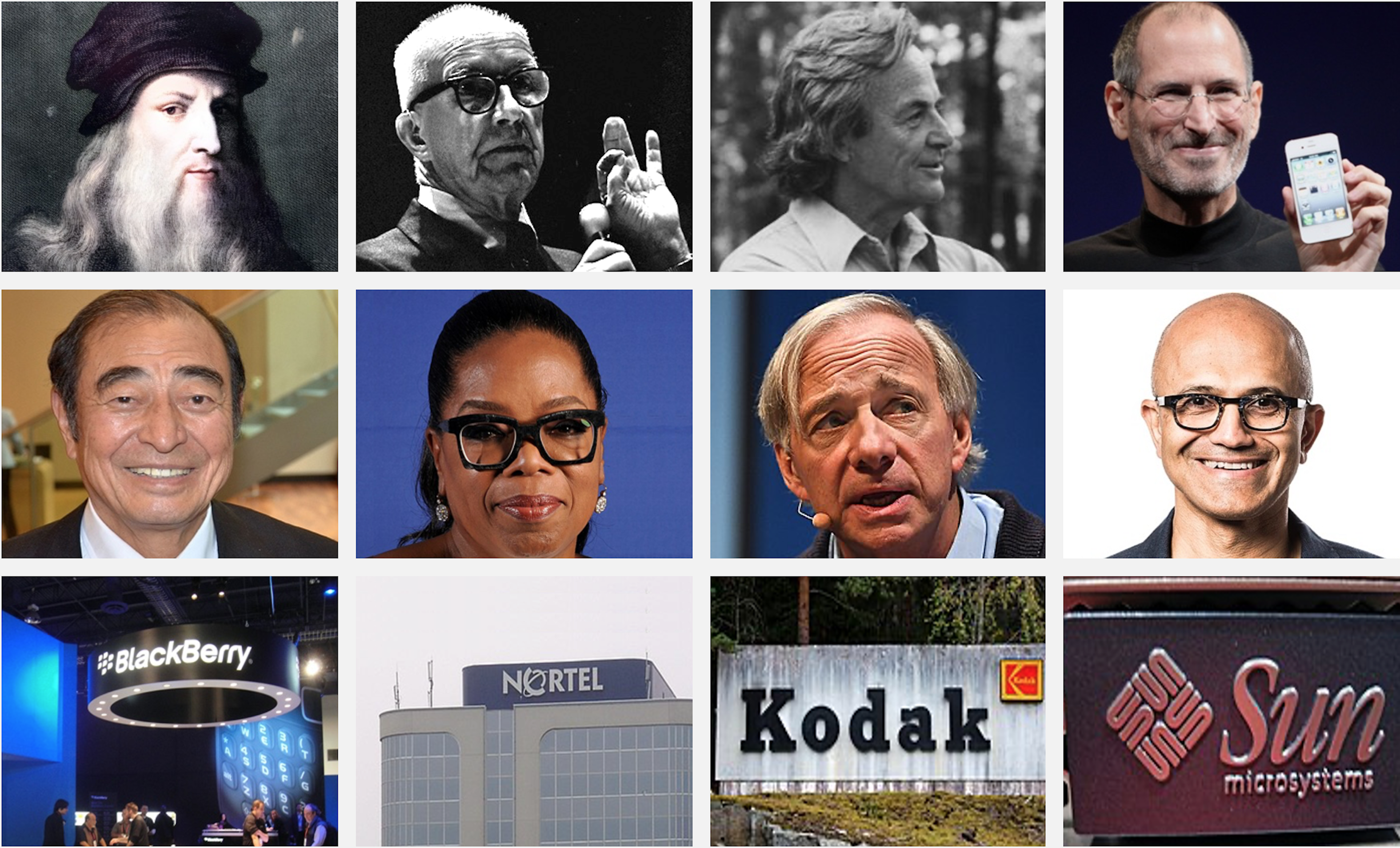
• Alcoa (1987 through 1995). Major company turnaround, led by new CEO Paul O’Neill. • IBM (1993 through 1995). Successful company turnaround. 1IBM (1993): Check out then-CEO Lou Gerstener’s compelling memoir of the turnaround: Who Says Elephants Can’t Learn to Dance? • Apple (1997 through 2000). The return of Steve Jobs, and a transformative company turnaround. 2Apple (1997): This turnaround provides a wealth of lessons. • Other top examples of success include: ________; __________; ___________; and others. 3Possibly add a few further names in the FN for these … .
|
• ‘Chainsaw Al’ (the 1990s). Short-lived financial changes that produced long-term disasters and ultimate failure.4For an overview, see the HBR article, “Cracking the Code of Change.” • Name of Co (198_ through 198_). Failure to _____. 5Name of Co: The failure at ________ was ____. See: [citation], Chapter __. . |
Since 2000:
| Successful Transformations, Turnarounds | Failure Stories |
|
• Fujifilm (2000 through 2010). Successful transformation of Fujifilm, led by Shigetaka Komori, despite the disappearance of their core business, photographic film. 6The best book on the topic is Komori’s own memoir of the transformation, Innovating Out of a Crisis. • AMD (2014 through 2016). Successful transformation led by new CEO Lisa Su. • Microsoft (2014-2017). Global transformation to a corporate culture grounded in a Growth Mindset.7For an overview, see 8 Key Steps Satya Nadella Took to Transform Microsoft. • Nvidia (2012 to the present). Pioneer of a new kind of machine learning — now called ‘AI.’ 8For an overview, see Nvidia’s Greatest Achievement is Actually in Human Learning. • Other top examples of success include: AirBnb (_____); Door Dash (______); Shopify (______); __________; ___________; and others. 9Possibly add a few further names in the FN for these … .
|
• Blackberry (2007 through 2014). Failure to modernize the once-dominant Blackberry phone. 10Blackberry: The failure at Blackberry from 2007 through 2010 serves as a textbook example of just how easy it is for smart people to fall prey to the cognitive biases. In his book Think Again, Wharton business professor argues that the leaders were blinded by three cognitive biases in particular: Cognitive Entrenchment, Confirmation Bias, and Over-confidence Bias. See Adam Grant, Thinking Again: _________ [citation], Chapter __. . • Nortel Networks (2001 through 2008). Top example of overconfidence leading to ignoring clear threats and outside trends. 11Nortel Networks: According to an in-depth study of the failure, the major problem was “hubris” and “arrogance” of Nortel’s leaders. See How Hubris and Arrogance Killed Nortel Networks. • Sun Microsystems (2008 through 2011). Failure to expand beyond just hardware.12Sun Microsystems: The culture at Sun Microsystems kept leaders focused on their prominence in hardware, not on what customers were demanding. See Why Sun Microsystems Failed. • Other top examples of failure include: Blockbuster (2003-2005); Kodak (2004-2009); Nokia (2010-2012); Theranos (2019-22); FTX (2022-23); and others. 13Possibly add a short description of one of these. |
</
2. Personal Change | Personal Transformations
This is a separate Text Module for just the Opening Text of Body Section 2 … before the two Overview|List Tables. 14You COULD set out a Footnote here … but it should be mainly to describe how the Footnot/Sidenotes here are intended to be short concise statements of the key item/name in the Table.
Pre-2000:
Successful Personal Change, Transformations |
Failure Stories |
|
• Leonardo Da Vinci (19__ through 19__). Descrcibe the transformation.15Name: … state the key lesson. • Buckminster Fuller (19__ through 19__). Descrcibe the transformation.16Name: … state the key lesson. • Richard Feynman (19__ through 19__). Descrcibe the transformation.17Name: … state the key lesson. • Other top examples of success include: Winston Churchill; William James; William Shakespeare; Alexander _____ (mathematician); Oprah Winfrey; and others. 18Possibly add a few further names in the FN for these … .
|
• Ignaz Semmelweis (19__ through 19__). Descrcibe the transformation.19Name: … state the key lesson. • Nicholas II (19__ through 19__). Descrcibe the transformation.20Name: … state the key lesson. • Michael Wheeler (19__ through 19__). Descrcibe the transformation.21Name: … state the key lesson.
|
Since 2000:
| Successful Personal Change, Personal Growth | Failure Stories |
|
• Steve Jobs (2000 through 2011). Continued personal growth into “Jobs 2.0.” 22Jim Collins, Entrepreneurship 2.0 • Naval Ravikant (2000s to the present). Leading example of building unique special knowledge. • Anne Mulcahy (2001-2005). Stellar example of personal growth as the new CEO of Xerox.23 See the article, [D – add YOUR L2 article here … a short one]. • Jensen Huang (2000 to the present). Personal growth comes through overcoming difficulty. 24Here’s an introduction: ____________ (add citation here)
|
• Boris Becker (20__ through 20__). Failure to ____. 25Boris Becker: Becker himself has said he wants his mistakes to be an example for others to learn from. See: _________ [citation], Chapter __. . • Elizabeth Holmes (2010 through 2020). Example of the dangers of vaulting ambition driven mostly by external accolades and the trappings of power. 26Elizabeth Holmes: According to _____, _____. See Title of article or book. • Sam Bankman-Fried (20__ through 2022). Vaulting ambition leading to the misleading of investors and vast overconfidence.27 Bankman-Fried: For a great review, see Michael Lewis, Title of Book.
|
3. Social Change | Country Transformations
This is a separate Text Module for just the Opening Text of Body Section 1 … before the two Overview|List Tables. 28You COULD set out a Footnote here … but it should be mainly to describe how the Footnot/Sidenotes here are intended to be short concise statements of the key item/name in the Table.
Pre-2000:
Successful Social Change |
Failure Stories |
|
• South Africa | Nelson Mandela (1992 through 1994). Massive transformation despite the disappearance of their core business, photographic film. 29Fn would go here. • India | Mahatma Gandhi (19__ through 19__). Transformation of India to independence; Gandhi’s intelligence and wisdom as instrumental in that transformation.30One of the best accounts of this period is _____________. • Finland’s Education System (___ to the present). Successful transformation from one of the worst to one of the best education systems in the world. 31 For an excellent account, see: [The Best Students in the World, by ______ . • Other top examples of successful social transformation include: the creation of New Edinburgh (17th century0; the ; __________; ___________; and others. 32Possibly add a few further names in the FN for these … .
|
• Failure to Embrace Germ Science (18__ through 18__). Failure to accept the clear emerging evidence that germs cause diseases. 33The failure is a leading historical example of Overconfidence and Cognitive Entrenchment in any field. • Fall of Russia (2017). Overconfidence and lack of practical intelligence on the part of one leader (Nicholas II). 34For a brief summary, see: [D – this should be your L2 article]. • The Self-Esteem Movement (1980s through 1990s). Failure to understand the genuine sources of self-esteem, and blind acceptance of a wonky theory. See [Example to read].[/mfn]
|
Since 2000:
| Successful Transformations, Turnarounds | Failure Stories |
|
• British Cycling (2000 through 2010). Massive transformation from ‘worst to first,’ thanks to a simple dedication to continuous micro improvements. 35Fn would go here. • [____] (2014 through 2016). New CEO Lisa CEO radically focused AMD’s mission on a few clear products and priorities. The results were extraordinary.36AMD returned to profitability within a year. The story illustrates the need for a very focused mission, something harder to do than most people think. • [____] (2014-2017). Global transformation to a corporate culture grounded in a Growth Mindset.37 See 8 Key Steps Satya Nadella Took to Transform Microsoft. • Other top examples of successful social transformation include: ________; __________; ___________; and others. 38Possibly add a few further names in the FN for these … .
|
• The ‘Discovery Method’ Movement (Example: Alberta, 2007 through 2014). Failure to properly understand the Science of Learning’s genuine insights. 39The ‘Discovery Method’ Movement: The failure at [ ] from 2007 through 2010 serves as a textbook example of just how easy it is for smart people to fall prey to the cognitive biases. In his book Think Again, Wharton business professor argues that the leaders were blinded by three cognitive biases in particular: Cognitive Entrenchment, Confirmation Bias, and Over-confidence Bias. See Adam Grant, Thinking Again: _________ [citation], Chapter __. . • Iceland (2001 through 2008). Top example of overconfidence leading to ignoring clear threats and outside trends. 40Nortel Networks: According to an in-depth study of the failure, the major problem was “hubris” and “arrogance” of Nortel’s leaders. See How Hubris and Arrogance Killed Nortel Networks. • Canada’s Economic Decline (2015 through 2025). A demonstrable decline, as measured by 14 standard measures.41Canada’s Economic Decline: The … [state how everyone needs to learn the basic objective measures in economics]. See Canada’s Economic Decline, 2015-25: Have the Courage to Read the Data.
|
Key Takeaways | Take Action [H2, black.]
This is a separate Text Module for Body Section 1. It necessarily must remain in the same ROW for the full Article Body.42THIS is where you can now start to get into more serious setting out of cites and references.
Key Takeaway(s) [H3]
This now tests a Subheading sub-section where the Subheading title is a short sentence or perhaps a question. The H3 line height should be set throughout at 1.1em. The default setting of 1em makes these lines a bit too close.
Take Action [H3]
This would be text under the second Subheading the in Intro. Note that I generally think the first Footnote/Sidenote in the Intro/Body should come (at the earliest) at the end of the Intro. Generally, you want to keep the Introduction extremely simple and fast-paced pcmf/story.
References & Further Reading
- 1IBM (1993): Check out then-CEO Lou Gerstener’s compelling memoir of the turnaround: Who Says Elephants Can’t Learn to Dance?
- 2Apple (1997): This turnaround provides a wealth of lessons.
- 3Possibly add a few further names in the FN for these … .
- 4For an overview, see the HBR article, “Cracking the Code of Change.”
- 5Name of Co: The failure at ________ was ____. See: [citation], Chapter __. .
- 6The best book on the topic is Komori’s own memoir of the transformation, Innovating Out of a Crisis.
- 7For an overview, see 8 Key Steps Satya Nadella Took to Transform Microsoft.
- 8For an overview, see Nvidia’s Greatest Achievement is Actually in Human Learning.
- 9Possibly add a few further names in the FN for these … .
- 10Blackberry: The failure at Blackberry from 2007 through 2010 serves as a textbook example of just how easy it is for smart people to fall prey to the cognitive biases. In his book Think Again, Wharton business professor argues that the leaders were blinded by three cognitive biases in particular: Cognitive Entrenchment, Confirmation Bias, and Over-confidence Bias. See Adam Grant, Thinking Again: _________ [citation], Chapter __. .
- 11Nortel Networks: According to an in-depth study of the failure, the major problem was “hubris” and “arrogance” of Nortel’s leaders. See How Hubris and Arrogance Killed Nortel Networks.
- 12Sun Microsystems: The culture at Sun Microsystems kept leaders focused on their prominence in hardware, not on what customers were demanding. See Why Sun Microsystems Failed.
- 13Possibly add a short description of one of these.
- 14You COULD set out a Footnote here … but it should be mainly to describe how the Footnot/Sidenotes here are intended to be short concise statements of the key item/name in the Table.
- 15Name: … state the key lesson.
- 16Name: … state the key lesson.
- 17Name: … state the key lesson.
- 18Possibly add a few further names in the FN for these … .
- 19Name: … state the key lesson.
- 20Name: … state the key lesson.
- 21Name: … state the key lesson.
- 22Jim Collins, Entrepreneurship 2.0
- 23See the article, [D – add YOUR L2 article here … a short one].
- 24Here’s an introduction: ____________ (add citation here)
- 25Boris Becker: Becker himself has said he wants his mistakes to be an example for others to learn from. See: _________ [citation], Chapter __. .
- 26Elizabeth Holmes: According to _____, _____. See Title of article or book.
- 27Bankman-Fried: For a great review, see Michael Lewis, Title of Book.
- 28You COULD set out a Footnote here … but it should be mainly to describe how the Footnot/Sidenotes here are intended to be short concise statements of the key item/name in the Table.
- 29Fn would go here.
- 30One of the best accounts of this period is _____________.
- 31For an excellent account, see: [The Best Students in the World, by ______ .
- 32Possibly add a few further names in the FN for these … .
- 33The failure is a leading historical example of Overconfidence and Cognitive Entrenchment in any field.
- 34For a brief summary, see: [D – this should be your L2 article].
- 35Fn would go here.
- 36AMD returned to profitability within a year. The story illustrates the need for a very focused mission, something harder to do than most people think.
- 37See 8 Key Steps Satya Nadella Took to Transform Microsoft.
- 38Possibly add a few further names in the FN for these … .
- 39The ‘Discovery Method’ Movement: The failure at [ ] from 2007 through 2010 serves as a textbook example of just how easy it is for smart people to fall prey to the cognitive biases. In his book Think Again, Wharton business professor argues that the leaders were blinded by three cognitive biases in particular: Cognitive Entrenchment, Confirmation Bias, and Over-confidence Bias. See Adam Grant, Thinking Again: _________ [citation], Chapter __. .
- 40Nortel Networks: According to an in-depth study of the failure, the major problem was “hubris” and “arrogance” of Nortel’s leaders. See How Hubris and Arrogance Killed Nortel Networks.
- 41Canada’s Economic Decline: The … [state how everyone needs to learn the basic objective measures in economics]. See Canada’s Economic Decline, 2015-25: Have the Courage to Read the Data.
- 42THIS is where you can now start to get into more serious setting out of cites and references.